How we analyse and score
We compare robot vacuums using their publicly available specifications, documentation and buyer reviews. Our analysis considers the home and floor types involved, distinguishing between advertised features, maintenance requirements and the limitations of the available information.
What “analysis” means here
We do not physically test products. Specifications come from the sources consulted, and buyer feedback describes individual situations. Missing information or data that is difficult to compare is flagged as such; it is never treated as evidence of assumed performance.
A manufacturer's claimed specification is not measured performance, and a customer review is not an analysis result. We keep these three types of evidence separate, both on the page and in our calculations.
Our evidence trail
- 1Exact modelThe full model name, variant and market. Two versions of the same product are never combined.
- 2Published dataManufacturer specifications and retailer listings, recorded on a specific date for the exact model.
- 3Catalogue comparisonEach value is compared with those of all other models on the same scale.
- 4Verdict in contextWho the model suits, and when to choose another.
Data we do not have stays missing. It is never guessed, replaced with an average or counted as zero.
How we assess robot vacuum cleaners
These criteria are fixed across the category and applied in the same order to every model. This lets you compare two analyses line by line, instead of reading two reviews that cover different things.
- Max coverage higher is better · m²
- Dustbin capacity higher is better · ml
- Charging time lower is better · h
- Battery life higher is better · min
- Suction power higher is better · pa
- Equipmentdocumented features among those tracked for the category: more features mean a higher score
A criterion is scored only if the relevant specification is documented for the model. Across the site's 46 scored analyses: Max coverage out of 10, Dustbin capacity out of 28, Charging time out of 19, Battery life out of 38, Suction power out of 34, Equipment out of 46.
This is why a product page displays between 2 and 6 scores. Each page explains which criteria are not scored and why in “Our scores explained”.
A model is not penalised for a feature it never promised. It is assessed in the context of its price and intended users, using criteria relevant to its category.
How the score is calculated
The score out of 10 is the average of individual scores, one for each criterion in the table above. An individual score is not an impression: it is themodel's position across the full catalogueon this measure. That's why each row shows the figures behind it, such as “210 min, ahead of 80% of models in the catalogue”. You can cross-check them.
When our data doesn't cover a criterion for a given model, the row makes this clear: it is shown as anassessment based on published specifications, rather than a measurement. The page clearly distinguishes between the two.
What we never do:
- fill in a missing specification with an assumption;
- score two models using different methods;
- turn a result that depends on your needs into an overall winner;
- publish a score when the data is too weak to support it.
A score reflects our assessment at a given time. It is relative to the catalogue: whenever scores are updated, all product pages are recalculated against the current catalogue, so a score can change as new models are added. Scores last updated: 2 November 2026.
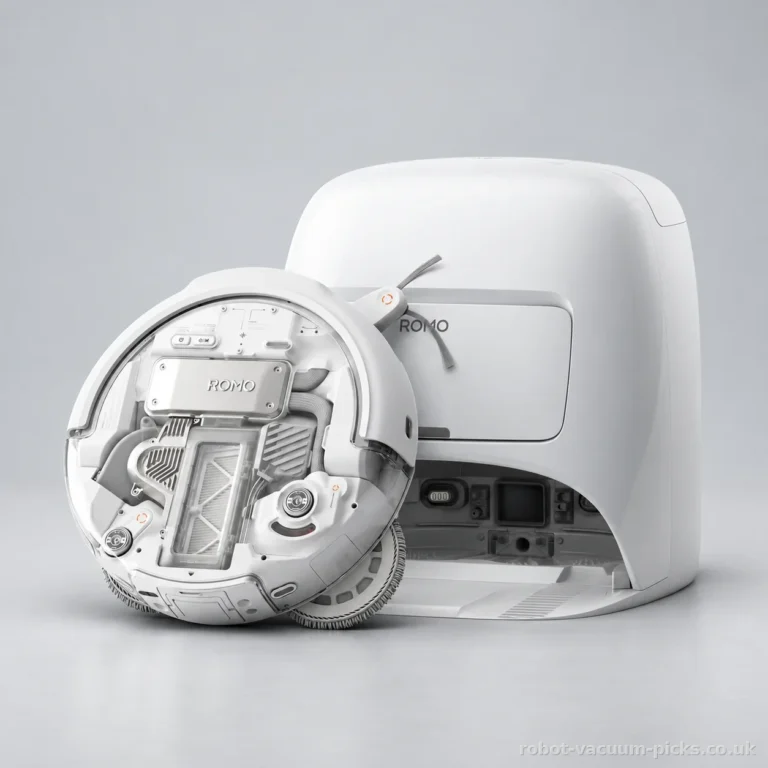
A real example: DJI Romo A
Here's how the “Battery life” score for DJI Romo A is calculated, exactly as shown on its product page, one of the site's best-documented analyses.
Battery life: 8.6/10
Two model counts: the rank and average include models with a product page scored on this criterion; the calculation compares this model with all catalogue models with a verified specification, whether or not they have a product page. A score assigned at publication may remain without a verified specification, so the first count can be higher.
DJI Romo A scores 8.6/10 on this criterion. Across the site's 38 product listings with a score on this criterion, the average is 8.2: above average, 11 of 38.
| Common baseline: last place in the ranking | 6.5 |
|---|---|
| Battery life: 180 min ; 32 rank lower, 12 rank higher, 11 are tied (including this model), among the 55 catalogue models with this specification verified | +2.1 |
| Battery life score | 8.6/10 |
Calculation: (32 + 11 ÷ 2) ÷ 55 = 68.18% of the ranking; 6.5 + 68.18% × 3.1 = 8.6/10, rounded to one decimal place.
Complete or partial documentation
Beside the overall score, each product page shows whether the category's 5 key specifications are confirmed by a verified source (an archived retailer page or manufacturer documentation): Max coverage, Dustbin capacity, Charging time, Battery life, Suction power. It displays “Documentation: complete” when all are confirmed, or “partial” otherwise, with missing details shown on hover. In the specifications table, any of these 5 specifications that are not confirmed are labelled “unverified”; other rows in the table are not covered by this check.
Partial documentation does not lower the score: a criterion with an unconfirmed value is not scored and is excluded from the average. The only exception is a score assigned when the analysis was published, which is retained while the product page has fewer than 3 verified criteria; this is flagged in the page's “Our scores explained” section.
Currently, 2 product pages have complete documentation and 43 have partial documentation.
Our sources and how we weigh them
- Manufacturer documentationOfficial pages, manuals and specification sheets. We use these to identify the claims made. Manufacturer promises are always presented as claims.
- Retailer pagesThese confirm the exact model, included accessories and recorded price for the relevant market. A limited-time offer is never presented as a permanent price.
- Customer feedbackWe look for recurring themes, rather than isolated comments, taking into account reviews that mix different variants and the sample size.
- Published specialist analysesThese help us compare claims with observations. We don't copy their verdicts or average their scores.
When sources disagree, we flag it rather than force a conclusion.
Prices
We don't display prices beside retailer links. A price recorded once soon becomes outdated, and an incorrect figure beside a buy button lets down the reader it was meant to help. Prices in our comparison tables and filters show where a model sits in the range and help you sort by budget: the price that applies is the one shown by the retailer when you buy.
Independence and affiliate links
No brand pays to appear in our selections or improve its score. Some links to retailers are affiliate links: if you buy through them, we may earn a commission,at no extra cost to you.
Whether we earn a commission, and how much, plays no part in our criteria. Affiliate revenue funds the site; it doesn't determine our rankings.
Updates and corrections
An analysis is updated when the model changes, when information proves incorrect, or when new models shift its position in the catalogue. The last updated date is shown on every page.
This site is written and checked by Romain Brunel. An error, information that's changed, a missing model: let us know and we'll correct the page.
Browse our analyses →